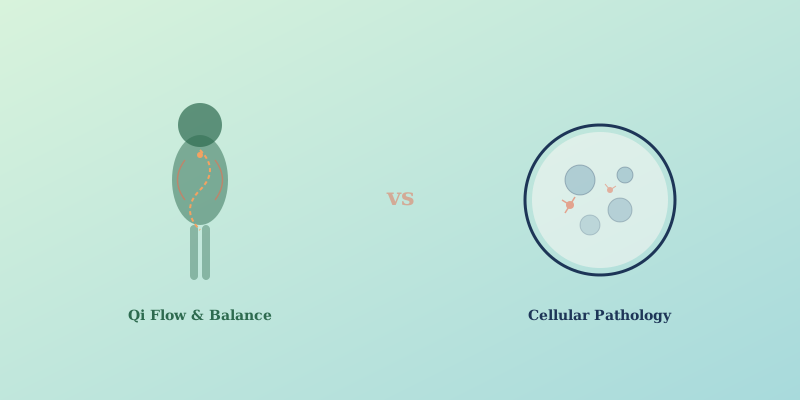
At the heart of every medical system lies a fundamental question: why do people get sick? The answer shapes everything — how diagnosis is conducted, which treatments are chosen, and what "recovery" means. Traditional Chinese Medicine and Western medicine provide strikingly different answers, yet each captures truths that the other tends to overlook.
The TCM Model: Imbalance and Disharmony
TCM does not view disease as something that invades from outside and must be destroyed. Instead, it sees illness as a disruption of the body's natural harmony — a state that can be restored through rebalancing.
Qi: The Vital Force
Central to TCM is the concept of Qi (pronounced "chee") — the vital energy that flows through the body along pathways called meridians. When Qi flows freely and in sufficient quantity, the body is healthy. When Qi becomes stagnant, deficient, or rebellious (flowing in the wrong direction), symptoms arise. A headache might be caused by Liver Qi rising; fatigue might reflect Spleen Qi deficiency; a cold might result from Wind-Cold invading when Wei Qi (defensive energy) is weak.
Yin-Yang Theory
Every physiological process in TCM is understood through the yin-yang framework — two complementary, interdependent forces. Yin represents cooling, nourishing, and substantive qualities; Yang represents warming, activating, and functional qualities. Health is a dynamic balance between the two. A fever with night sweats might indicate Yin deficiency (not enough cooling); persistent cold limbs might signal Yang deficiency (not enough warming).
The Five Elements
The Five Element theory (Wood, Fire, Earth, Metal, Water) maps relationships between organ systems, emotions, seasons, tastes, and colours. Each element generates and controls others in defined cycles. The Liver (Wood) nourishes the Heart (Fire) but controls the Spleen (Earth). This framework explains how dysfunction in one organ can cascade through the body — a concept that resonates with modern systems biology.
Organ Pattern Syndromes
TCM organs (Zang-Fu) are functional concepts rather than purely anatomical structures. The TCM "Kidney" encompasses not just the renal organs but also reproductive function, bone health, hearing, willpower, and ageing. Disease is described as a specific pattern involving one or more organs — for example, "Heart Blood deficiency" might manifest as insomnia, palpitations, poor memory, and a pale complexion.
The Western Model: Pathology at the Cellular Level
Western medicine's understanding of disease underwent a revolution in the 19th century with the emergence of germ theory, cellular pathology, and biochemistry. These frameworks form the foundation of modern biomedicine.
Germ Theory
The work of Louis Pasteur, Robert Koch, and others established that many diseases are caused by specific microorganisms — bacteria, viruses, fungi, and parasites. This insight led directly to vaccines, antibiotics, antiseptic surgery, and public health sanitation. Germ theory remains the bedrock of infectious disease medicine and one of the greatest achievements in the history of science.
Cellular Pathology
Rudolf Virchow's principle — "Omnis cellula e cellula" (every cell comes from a cell) — shifted the understanding of disease to the cellular level. Cancer became understood as uncontrolled cell division; autoimmune disease as the immune system attacking healthy cells; diabetes as dysfunction in insulin-producing beta cells. This precision allows targeted interventions: surgically removing a tumour, replacing a defective gene, or blocking a specific enzyme.
Genetics and Molecular Biology
The discovery of DNA and the mapping of the human genome added another layer. Inherited mutations explain conditions from sickle cell disease to BRCA-related cancers. Pharmacogenomics now tailors drug selection to a patient's genetic profile — the frontier of personalised medicine.
The Biopsychosocial Model
It is worth noting that Western medicine has not remained purely reductionist. George Engel's biopsychosocial model (1977) acknowledged that disease arises from the interplay of biological, psychological, and social factors. However, in clinical practice, the biological dimension still dominates most diagnostic and treatment decisions.
TCM View of Disease
- Disease = disrupted balance of Qi, Yin-Yang, and organ harmony
- The body's internal "terrain" determines vulnerability
- Same pathogen can cause different patterns in different people
- Treatment goal: restore harmony and strengthen the body's self-healing capacity
- Prevention through lifestyle, diet, and emotional regulation
Western View of Disease
- Disease = specific pathological changes at the cellular or molecular level
- Identifying the causative agent or mechanism is paramount
- Same disease in different people receives the same diagnosis
- Treatment goal: eliminate the pathogen, correct the defect, or remove the pathology
- Prevention through vaccination, screening, and risk-factor modification
The Terrain vs. the Pathogen: An Old Debate Revisited
A famous (possibly apocryphal) exchange captures this tension: on his deathbed, Louis Pasteur is said to have conceded, "The microbe is nothing; the terrain is everything." Whether he actually said this is debated, but the sentiment reflects a real tension in medicine that persists today.
TCM has always been a "terrain" medicine — focused on the internal environment that allows disease to take hold. Why do some people catch every cold while others remain healthy through flu season? TCM would point to the strength of Wei Qi and the balance of internal organ systems.
Western medicine has historically been a "pathogen" medicine — identifying and attacking the external cause. But fields like the microbiome, epigenetics, psychoneuroimmunology, and functional medicine are increasingly acknowledging that the terrain matters enormously. The gut microbiome, for instance, can determine whether a pathogen causes illness or is neutralised — a concept that TCM's attention to digestion (the Spleen-Stomach system) anticipated by centuries.
Where the Two Philosophies Converge
Despite their different languages, several areas of convergence are emerging:
- Systems biology studies the body as an interconnected network — echoing TCM's Five Element cycles and organ interrelationships.
- Psychoneuroimmunology confirms that emotional states affect immune function — validating TCM's organ-emotion connections (e.g., grief weakening the Lung).
- Chronobiology recognises that organ systems have peak activity times — a concept central to the TCM meridian clock.
- Epigenetics shows that lifestyle and environment alter gene expression without changing DNA — resonating with TCM's emphasis on diet, exercise, and emotional balance as medicine.
How They Complement Each Other
The TCM philosophy of disease is strongest in chronic, multifactorial, and functional conditions where the "terrain" is the primary driver. Western medicine's disease model is strongest in acute, infectious, structural, and genetic conditions where a specific cause can be identified and targeted. A truly comprehensive understanding of human health may require both lenses — the molecular and the systemic, the pathogen and the terrain.
Key Takeaway
TCM asks: "What internal imbalance allowed this illness to arise?" Western medicine asks: "What specific mechanism is causing this pathology?" Neither question alone captures the full picture. The most promising frontier in medicine may lie in learning to ask both questions simultaneously.