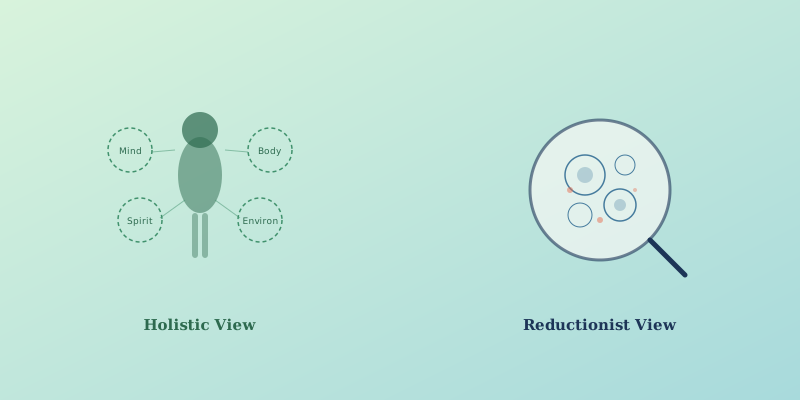
If you visit a TCM practitioner for migraines, you may find yourself discussing your menstrual cycle, your temperament, and your relationship with anger. Visit a neurologist for the same complaint, and you will likely discuss aura characteristics, receive an MRI referral, and be offered a triptan prescription. Both are trying to help — but their fundamental paradigms about what constitutes proper medical thinking could hardly be more different.
The Holistic Paradigm in TCM
Holism in TCM is not a marketing slogan — it is a foundational principle woven into every aspect of diagnosis and treatment. The core idea is that the body, mind, emotions, and environment form a single interconnected system, and you cannot meaningfully address a problem in one area without considering the others.
Mind-Body-Spirit Unity
In TCM, there is no hard boundary between physical and mental health. Emotions are directly linked to organ systems: grief affects the Lung, anger affects the Liver, worry affects the Spleen, fear affects the Kidney, and excessive joy affects the Heart. A patient presenting with digestive issues might receive treatment aimed at calming worry; a patient with chronic shoulder tension might be treated for Liver Qi stagnation related to suppressed frustration.
Individualised Treatment
Because TCM treats patterns rather than diseases, two patients with identical Western diagnoses may receive completely different TCM treatments. Ten patients with depression might receive ten different herbal formulas, each tailored to their specific pattern of disharmony. This radical individualisation is one of TCM's greatest strengths — and one of its greatest research challenges.
Contextual Medicine
TCM considers the patient's environment integral to health. Season, climate, geography, diet, daily habits, work-life balance, and social relationships all factor into the diagnostic and treatment framework. The same formula might be modified based on whether the patient lives in a damp coastal climate or a dry inland region.
Prevention as Priority
The classical TCM ideal, expressed in the Huangdi Neijing, is to treat disease before it arises: "The superior physician treats what is not yet ill." Dietary therapy, qigong, tai chi, seasonal living, and emotional cultivation are not supplementary lifestyle tips — they are first-line medicine.
The Reductionist Paradigm in Western Medicine
Reductionism is the principle that complex phenomena can be understood by studying their smallest component parts. In medicine, this means breaking disease down to its molecular, cellular, and genetic mechanisms — and designing interventions that target those specific mechanisms.
Specialisation
Western medicine's success has been built on specialisation. Cardiologists focus on the heart, endocrinologists on hormones, oncologists on cancer, psychiatrists on the brain. This depth of expertise produces extraordinary outcomes: open-heart surgery, organ transplants, targeted cancer immunotherapy. No other medical system in history has achieved this level of precision.
Standardised Protocols
Evidence-based medicine (EBM) aims to ensure that every patient with a given condition receives the best-proven treatment, regardless of which doctor they see. Clinical guidelines, drawn from systematic reviews of randomised controlled trials, create a standardised floor of quality. This is a genuine achievement — it means a patient in a rural clinic should, in principle, receive the same quality of care as one at a teaching hospital.
Measurability and Reproducibility
Everything in Western medicine aspires to be measurable: drug dosages, tumour sizes, blood glucose levels, mortality rates. This allows rigorous comparison between treatments, identification of harm, and continuous improvement. The scientific method, applied to medicine, has eradicated smallpox, turned HIV from a death sentence into a manageable condition, and made surgery survivable.
Strengths of Holism
- Sees the patient as a whole person, not a collection of parts
- Naturally addresses comorbidities and root causes
- Excels at chronic, multifactorial, and functional conditions
- Emphasises prevention and lifestyle as primary medicine
- Accounts for emotional and environmental contributors to illness
Strengths of Reductionism
- Produces precise, targeted interventions with measurable outcomes
- Enables surgical repair of specific anatomical problems
- Excels at acute, infectious, and structural conditions
- Allows large-scale research and standardised quality of care
- Builds cumulative, self-correcting scientific knowledge
The Limits of Each Paradigm
When Holism Falls Short
A holistic framework cannot set a broken femur, remove a ruptured appendix, or kill a bacterial meningitis infection. In acute emergencies and structural pathology, the precision of Western reductionism is literally lifesaving. TCM's resistance to standardisation also makes it harder to scale, quality-control, and subject to rigorous comparative research.
When Reductionism Falls Short
Reductionism has a well-documented blind spot: the patient who falls between specialties. A person with chronic fatigue, brain fog, joint pain, and anxiety may bounce between a rheumatologist, a neurologist, a psychiatrist, and an endocrinologist — each finding nothing wrong within their narrow domain. The system is optimised for single-organ disease; it struggles with whole-person dysfunction.
Western medicine has also been criticised for over-reliance on pharmaceutical interventions while undervaluing diet, sleep, stress management, and social connection — factors that TCM has centred for millennia. The rise of iatrogenic illness (disease caused by medical treatment itself), polypharmacy in elderly patients, and the opioid crisis are, in part, consequences of a system that excels at treating parts but sometimes loses sight of the whole.
Bridging the Gap: Systems Biology and Functional Medicine
Encouragingly, several movements within Western science are moving toward a more holistic orientation:
- Systems biology uses computational models to study the body as an integrated network of interacting systems — conceptually similar to TCM's relational organ model.
- Functional medicine explicitly focuses on root causes and treats the whole patient, drawing heavily on lifestyle interventions — often using language that echoes TCM principles.
- Network pharmacology studies how multi-compound medicines (like TCM herbal formulas) act on multiple targets simultaneously — validating the TCM approach of using synergistic combinations.
- Lifestyle medicine is gaining recognition as a medical specialty, with evidence-based protocols for diet, exercise, sleep, stress management, and social connection as primary treatments.
These fields suggest that the future of medicine may not be a victory of one paradigm over the other, but a synthesis that combines reductionist precision with holistic breadth.
How They Complement Each Other
The most effective care may use reductionist tools within a holistic framework. A cancer patient might receive chemotherapy (targeted reductionism) while also receiving acupuncture for nausea, dietary therapy for nutritional support, and qigong for emotional resilience (holistic care). The chemotherapy attacks the tumour; the holistic care supports the patient through the process and addresses the terrain that allowed the disease to develop.
This is not "alternative" medicine replacing conventional care — it is integrative medicine using the best of both paradigms, each in its area of strength.
Key Takeaway
Holism without precision can miss critical pathology. Reductionism without context can miss the patient. The future of medicine lies not in choosing one paradigm over the other, but in knowing when to zoom in and when to zoom out — and having the tools to do both.