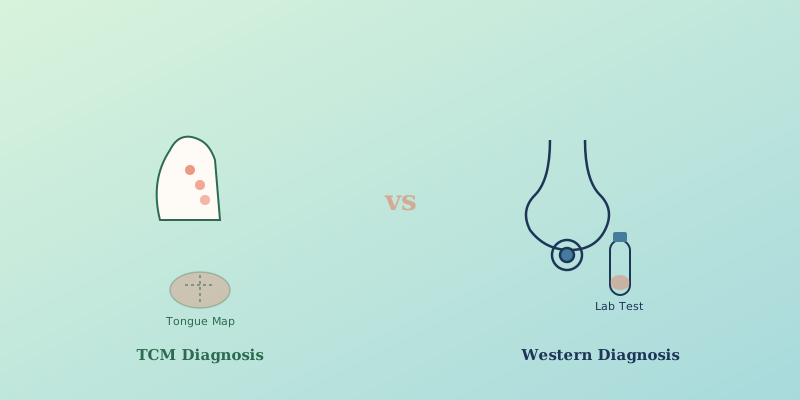
Diagnosis is where every medical encounter begins. Before a treatment plan can be formed, the practitioner must first determine what is wrong. Yet the way Traditional Chinese Medicine (TCM) and Western medicine answer that question could hardly be more different. TCM relies on sensory observation, pattern recognition, and a deeply relational understanding of the body. Western medicine leans on laboratory data, imaging technology, and measurable biomarkers. Understanding both approaches reveals not just their differences, but the possibility that each can catch what the other misses.
How TCM Diagnoses: The Four Examinations
TCM diagnosis is built on a framework known as the Four Examinations (Si Zhen), a systematic method codified over two millennia ago in texts like the Huangdi Neijing. These four pillars are observation, listening and smelling, questioning, and palpation.
1. Observation (Wang Zhen)
The practitioner assesses the patient's overall appearance — complexion, posture, body shape, and movement. The single most important observational tool is tongue diagnosis. The tongue is considered a map of the internal organs: its colour, shape, coating, moisture, and movement all convey diagnostic information. A pale, swollen tongue with teeth marks might suggest Spleen Qi deficiency, while a red tongue with a yellow coating could indicate internal heat.
2. Listening and Smelling (Wen Zhen)
The quality of the voice, breathing patterns, cough sounds, and even body odour provide clues. A weak, breathy voice may suggest Qi deficiency, while a loud, forceful voice might point to excess conditions.
3. Questioning (Wen Zhen)
TCM practitioners conduct extensive interviews covering areas that Western doctors might consider unrelated to the chief complaint — sleep patterns, appetite, thirst preferences, bowel habits, emotional state, sensitivity to temperature, and sweating patterns. The classical "Ten Questions" framework ensures a comprehensive picture of the patient's internal landscape.
4. Palpation (Qie Zhen)
Pulse diagnosis is perhaps the most iconic TCM skill. The practitioner feels the radial artery at three positions on each wrist, at three depths of pressure, assessing up to 28 classical pulse qualities — such as wiry, slippery, choppy, or thin. Each position corresponds to specific organ systems. A skilled practitioner can detect patterns of disharmony long before they manifest as measurable pathology.
How Western Medicine Diagnoses
Western diagnosis follows a process of differential diagnosis — generating a list of possible conditions and systematically narrowing it down through objective testing.
History and Physical Examination
Like TCM, Western medicine begins with a patient interview and physical exam. However, the focus is on identifying specific signs and symptoms that correlate with known disease entities. Vital signs (blood pressure, heart rate, temperature, respiratory rate) provide baseline data. Physical examination techniques — inspection, auscultation, percussion, and palpation — share surface similarities with TCM's Four Examinations but are interpreted through an entirely different theoretical lens.
Laboratory Testing
Blood tests, urinalysis, biopsies, genetic panels, and microbial cultures allow Western medicine to identify disease at the molecular level. A complete blood count can detect anaemia or infection; liver function tests reveal hepatic stress; tumour markers can flag early malignancies. These objective measurements are the backbone of Western diagnostic confidence.
Imaging Technology
X-rays, CT scans, MRI, ultrasound, and PET scans give clinicians the ability to see inside the living body with remarkable precision. A torn ligament, a growing tumour, or a blocked artery can be identified and located before any surgical intervention.
Specialised Testing
Electrocardiograms (ECG), endoscopy, colonoscopy, nerve conduction studies, and pulmonary function tests provide targeted diagnostic data for specific organ systems — a level of anatomical precision that TCM does not attempt.
TCM Diagnostic Strengths
- Detects subtle patterns of imbalance before disease manifests
- Considers the whole person — emotions, lifestyle, constitution
- Non-invasive and low-cost (no equipment needed)
- Excels at identifying functional disorders that lack clear biomarkers
- Highly personalised — two patients with the same Western diagnosis may receive different TCM diagnoses
Western Diagnostic Strengths
- Objective, reproducible, and standardised measurements
- Identifies specific pathogens, genetic mutations, and structural damage
- Catches life-threatening conditions (cancers, clots, fractures) with precision
- Enables population-level screening and epidemiology
- Results are universally interpretable across practitioners and institutions
Where Do They Differ Most?
The deepest difference is what each system considers a valid finding. In Western medicine, a diagnosis without objective evidence — a normal blood panel, a clean MRI — often means "nothing is wrong." In TCM, the same patient might present with a clearly identifiable pattern such as Liver Qi stagnation or Kidney Yin deficiency, warranting treatment. This is why many patients with functional disorders — irritable bowel syndrome, chronic fatigue, fibromyalgia — turn to TCM after Western tests come back normal.
Conversely, TCM pulse and tongue diagnosis lack the inter-rater reliability that Western medicine demands. Two TCM practitioners may interpret the same pulse differently, and there is limited standardisation across training traditions. Western diagnostics, by contrast, are designed for reproducibility — the same blood sample should yield the same results in any accredited lab worldwide.
Pattern Recognition vs. Differential Diagnosis
TCM diagnosis results in a pattern identification (Bian Zheng) — a description of the overall disharmony, such as "Spleen Qi deficiency with Dampness accumulation." This pattern captures the interplay of multiple symptoms into a unified picture and directly informs the treatment strategy.
Western differential diagnosis results in a disease label — such as "type 2 diabetes" or "generalised anxiety disorder." This label is drawn from standardised classification systems (ICD-11, DSM-5) and points toward evidence-based treatment protocols.
Neither approach is inherently superior. Pattern identification captures the individuality of the patient; disease classification enables large-scale research and standardised care. The ideal situation may be one where both lenses are applied.
How They Complement Each Other
Integrative clinics are demonstrating that combining both diagnostic approaches can improve patient outcomes. A Western diagnosis of "irritable bowel syndrome" tells the doctor what the patient has; a TCM pattern identification of "Liver overacting on the Spleen" tells the practitioner why this particular patient developed it and how to tailor treatment to their constitution.
Some practitioners are also exploring whether TCM pulse patterns correlate with measurable cardiovascular metrics, and whether tongue-coating changes track with microbiome shifts — early research that could bridge the two diagnostic worlds with shared data.
Key Takeaway
TCM and Western diagnostic methods answer different questions. Western medicine excels at identifying what is structurally or biochemically wrong. TCM excels at identifying how the body's overall balance has shifted. For the most complete picture of a patient's health, the two approaches are not rivals — they are complementary lenses.