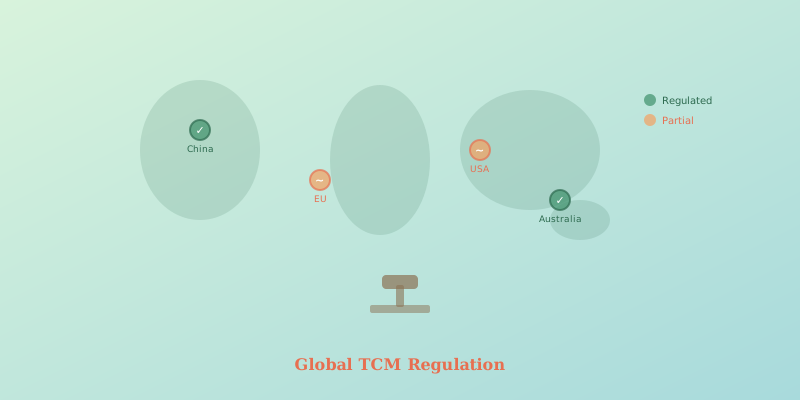
How a country regulates Traditional Chinese Medicine reflects its cultural values, healthcare priorities, and attitude toward medical pluralism. The regulatory landscape ranges from full integration (China) to near-prohibition (some countries ban certain herbal imports). Understanding these differences is essential for patients, practitioners, and policymakers.
Country-by-Country Overview
China — Full Integration
TCM is a fully integrated part of China's national healthcare system. The State Administration of Traditional Chinese Medicine oversees policy, education, and research. TCM practitioners are licensed through national examinations. TCM products are regulated as medicines (not supplements) and covered by national health insurance. China's 2016 TCM Law established the legal framework for equal treatment of both medical systems.
Japan — Kampo Within National Health Insurance
Japan adapted Chinese herbal medicine into its own tradition called Kampo. Uniquely, 148 standardised Kampo formulas are covered under Japan's national health insurance and can be prescribed by any licensed physician. Kampo is taught in over 80% of Japanese medical schools. Acupuncture is regulated separately, with licensed acupuncturists (Hari-shi) requiring national certification. Japan's model shows how herbal medicine can be standardised and integrated into a modern universal healthcare system.
South Korea — Dual-Licensed System
South Korea maintains a parallel system similar to China's. Korean Medicine (based on TCM principles) has its own universities, hospitals, and licensing system, completely separate from Western medicine. Korean Medicine doctors hold a distinct licence and cannot prescribe Western drugs, and vice versa. This clear separation ensures professional standards but can impede integration.
United States — Patchwork Regulation
Acupuncture: Regulated state-by-state. Most states require licensure (typically L.Ac.) based on NCCAOM certification and accredited education. Some states allow MDs and chiropractors to perform acupuncture with minimal additional training — a point of contention in the profession.
Herbal medicine: Chinese herbs are classified as dietary supplements under the 1994 DSHEA (Dietary Supplement Health and Education Act). This means they do not require FDA pre-market approval for safety or efficacy. Manufacturers cannot make disease treatment claims but can make "structure/function" claims. This regulatory gap means quality varies widely, and contamination incidents, while uncommon, do occur.
European Union — Traditional Use Registration
The EU's Traditional Herbal Medicinal Products Directive (THMPD, 2004) created a registration pathway for herbal medicines with at least 30 years of traditional use (15 within the EU). Registered products do not need to prove efficacy through clinical trials but must meet safety and quality standards. This pathway was controversial — some TCM products could not meet documentation requirements, effectively banning them in some EU markets. Individual EU countries also have national regulations: Germany is notably progressive (acupuncture covered by insurance for certain conditions), while others are more restrictive.
Australia — Statutory Practitioner Registration
Australia is one of the few Western countries with statutory registration for Chinese Medicine practitioners through the Australian Health Practitioner Regulation Agency (AHPRA). The titles "Chinese Medicine Practitioner," "Acupuncturist," and "Chinese Herbal Dispensing" are legally protected. Herbal products are regulated by the Therapeutic Goods Administration (TGA) — listed products (AUST L) meet quality and safety standards but are not assessed for efficacy; registered products (AUST R) require full efficacy evaluation.
United Kingdom — Voluntary Self-Regulation
Acupuncture and herbal medicine in the UK remain self-regulated through professional bodies (British Acupuncture Council, Register of Chinese Herbal Medicine). Plans for statutory regulation were proposed but never implemented. This means anyone in the UK can legally call themselves an acupuncturist — a situation that professional bodies and patient advocates have long criticised. Herbal medicines are regulated under the Traditional Herbal Registration scheme (aligned with EU THMPD prior to Brexit).
Canada — Provincial Variation
Regulation varies by province. British Columbia, Ontario, Alberta, Quebec, and Newfoundland have regulatory colleges for TCM/acupuncture. Other provinces have voluntary registration. Natural health products (including Chinese herbs) are regulated by Health Canada under the Natural Health Products Regulations, requiring a Natural Product Number (NPN) for sale.
Comparison Table
| Country | Acupuncture | Herbal Medicine | Insurance Coverage |
|---|---|---|---|
| China | Fully licensed | Regulated as medicines | Full national coverage |
| Japan | Licensed (Hari-shi) | 148 Kampo formulas on insurance | Kampo covered; acupuncture partially |
| South Korea | Licensed (separate system) | Korean Medicine pharmacies | Covered under national insurance |
| United States | State-licensed (varies) | Dietary supplements (DSHEA) | Expanding (Medicare for back pain) |
| Germany | Practised by Heilpraktiker or MDs | Traditional use registration (EU) | Insurance covers acupuncture for specific conditions |
| Australia | AHPRA statutory registration | TGA regulated | Private insurance extras |
| United Kingdom | Self-regulated (voluntary) | Traditional Herbal Registration | Limited NHS; mostly private |
| Canada | Provincial regulation (varies) | NHP Regulations (NPN required) | Some private plans cover acupuncture |
Key Regulatory Challenges
- Quality control of herbal products: Without mandatory GMP standards in all countries, contamination and adulteration remain risks.
- Practitioner standards: Where regulation is absent or voluntary, unqualified practitioners can harm patients and damage the profession's credibility.
- Evidence requirements: Balancing the demand for evidence with the recognition that traditional use constitutes a form of evidence is an unresolved policy tension.
- International harmonisation: The ISO Technical Committee on Traditional Chinese Medicine (ISO/TC 249) is working toward international standards for TCM terminology, herbal quality, and acupuncture needle safety — a slow but important process.
The Ideal Regulatory Framework
The best regulation protects patients without stifling access to safe, effective traditional medicine. Key elements include: mandatory practitioner licensing based on accredited education, quality standards for herbal products (GMP manufacturing, contaminant testing, clear labelling), adverse event reporting systems, and evidence-informed practice guidelines that acknowledge both clinical trial data and traditional use evidence. Australia's AHPRA model and Japan's Kampo integration are the most frequently cited examples of regulation that balances safety, access, and quality.
Key Takeaway
TCM regulation varies enormously worldwide — from full integration in East Asia to patchwork rules in the West. Patients should check their country's regulatory status, choose licensed or registered practitioners, and purchase herbal products from regulated suppliers. The global trend is toward greater regulation and integration, but progress is uneven.